25 June 2013, Twizel Bridge to Norham
If, like the aesthete, fish divide perfumes into light and dark, and bees classify luminosity in terms of weight…… the work of the painter, the poet or the musician, like the myths and symbols of the savage, ought to be seen by us, if not as a superior form of knowledge, at least as the most fundamental and the only one really common to us all; scientific thought is merely the sharp point – more penetrating because it has been whetted on the stone of fact, but at the cost of some loss of substance – and its effectiveness is to be explained by its power to pierce sufficiently deeply for the main body of the tool to follow the head.
Claude Levi-Strauss
Artists are often thought of as knowledge producers. This process is flattering for the artist, but it can also become means of dragging artists and artistic discourse into the realm of empirical and scientific thought, which can then see that knowledge packaged and appropriated for various uses far removed from the artists’ intentions.
How can we ‘know’ a river, if knowing means a way of realising or gathering knowledge? Given that our project Working the Tweed will of course take account of both scholastic and phenomenological approaches to knowledge production, one of my adopted ‘problems’, in a research sense, converges on the relative merits of these different forms of knowing. Is a walk by the river, senses alert and mind in low gear (if not absent), as effective a means of epistemological enquiry as a professionally administered scientific survey?
I’d like to think that in drawing on decades of research and practice, my midsummer walk from Twizel Bridge towards Norham, on the Northumbrian side of the Tweed, unveiled as much important and useful knowledge as the most rigorous of scientific surveys, though the nature of that knowledge is less measurable and therefore less easy to represent, or misrepresent, than the knowledge produced by scientific means.
Throughout the year I want to listen intently to various aspects of the river Tweed and its larger tributaries, in this case the mouth of the Till, with a view to establishing a modest typology or nascent archive of a variety of sites and walks where the visitor can engage with the river without suffering too much noise or intrusion. This is less an airbrushing exercise and more a search for the quiet places, which, I’m happy to report, do still exist.
Looking at the map of the Tweed catchment, and knowing the river systems well enough, it becomes clear to me that busy trunk roads run close alongside many of the larger rivers, largely for historical reasons. This particular stretch, Twizel Bridge to Norham, takes the walker off the main roads and away from the noise quite quickly and assumes a trail close in to the river, separated from most traffic noise by large arable and mixed fields, mature and new woodland plantation. Finally, the river valley itself provides fine acoustic cover from all but the more intimate river sounds.
Walking from the car park below the ruins of Twizel Castle , I took the path along the final reaches of the Till. This is uncomfortable walking at the height of summer because of an overgrown path, stinging nettles and various invasive flora of frightening proportions such as giant hogweed. The invasive species issue becomes immediately apparent – see it, touch it and know it. The path soon veers away from the road, passing beneath the Twizel Viaduct, offering glimpses of the Till, sandy and sluggish in its final mile. With more open views in early spring, autumn or winter this would be an excellent recreational walk with good river listening.
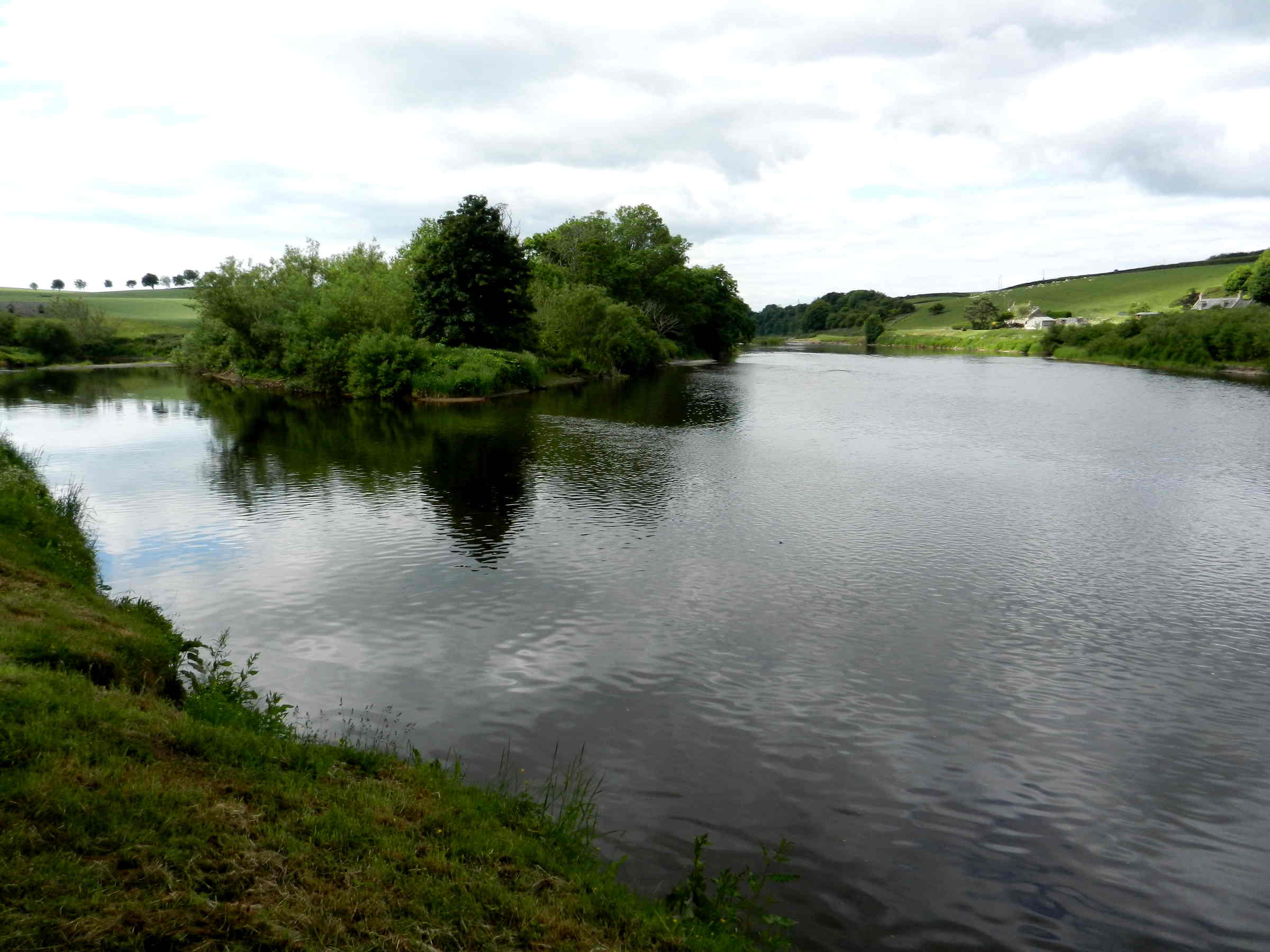
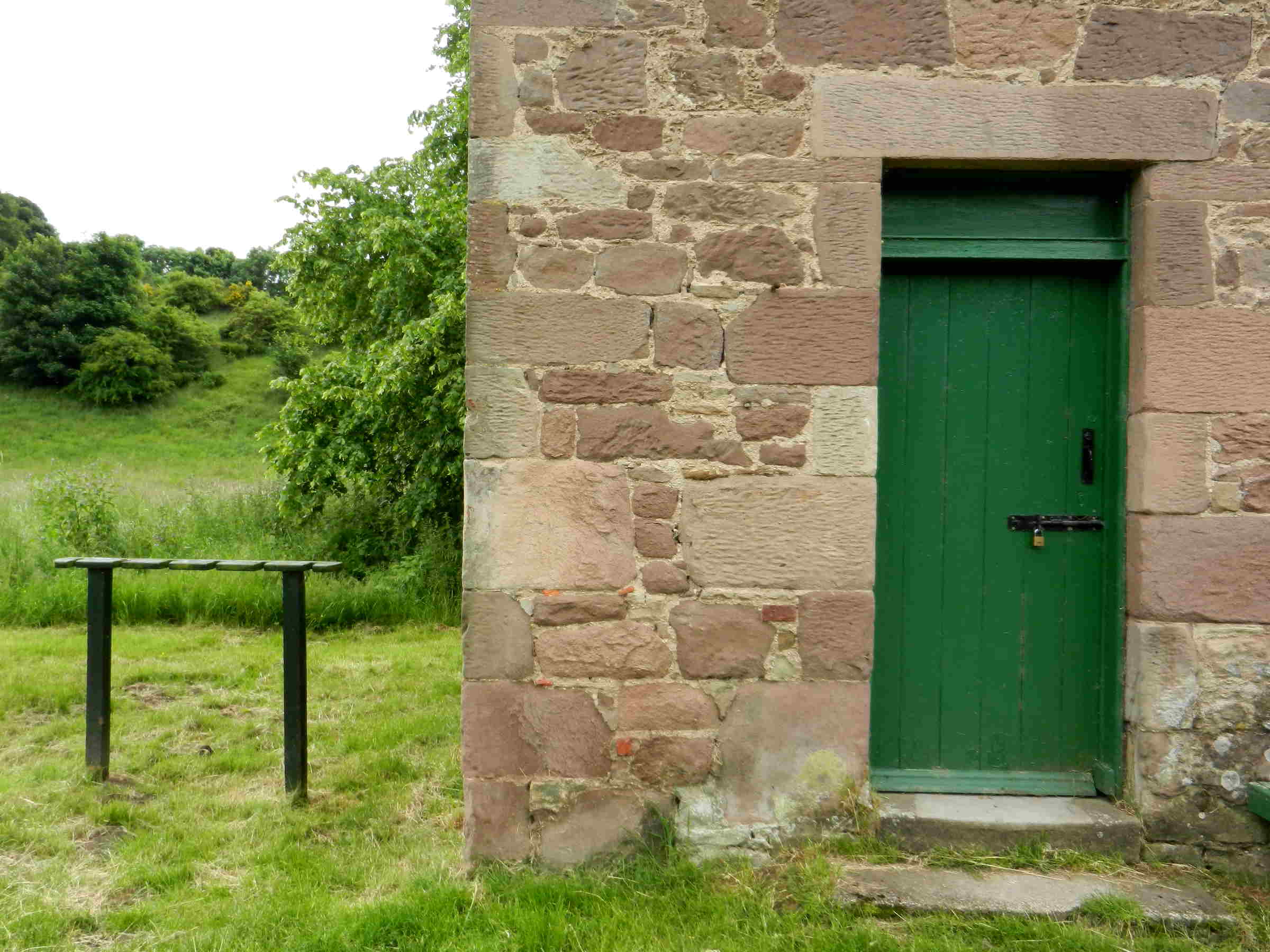
My first stop: facing southwest at Tillmouth proper with the Till on the left joining the Tweed on the right. Two standing anglers upstream and a cottage on the Scottish side having its verges trimmed by a noisy motorised tractor-mower. Rowing boats both sides the Tweed. The occasional vehicle on the B6437 reminds the listener just how far and with how much energy low frequencies will carry. The tractor-mower stopped for around forty minutes, conveniently allowing me to take a long recording, from the wooden bench by the rod-stand, and to digest my surroundings in relative peace. The recording will be archived until we decide what to do with these comnplex and problematic representations. Back to the river, you have to allow time for the soundscape to establish itself. Given enough time and gentle wide-field concentration, emergent properties become apparent, of which more at a future date.

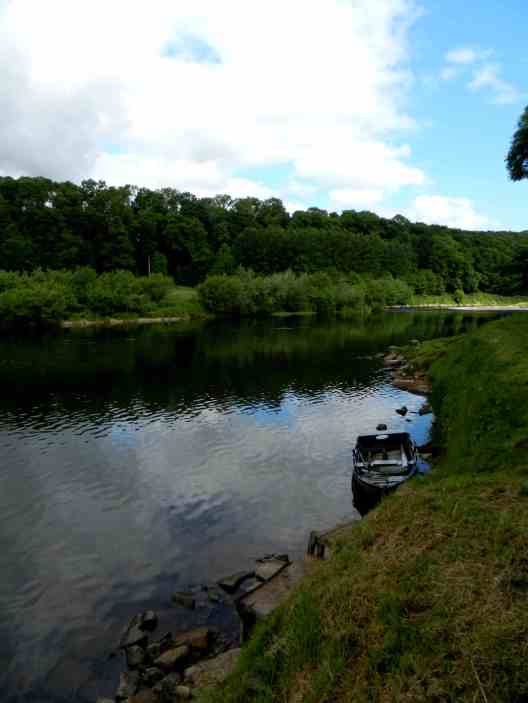
I’m no expert, but the birdlife here seems to be exceptionally rich, or more accurately the topography lends itself to a variety of species. Almost cacophonous at times, the birds dominate the recorded soundscape with their ceaseless foraging and chattering. The covering of deciduous behind me, in addition to harbouring all manner of unidentified tappings, whoopings and flutterings, echoed the wider field of sound from the large thick horizontal blanket expanse of mature broadleaf across the river, and from the smaller riparian trees along the main channel. I’ll take a chance and suggest that these might be ‘residual alluvial forests’. A fine range of contrasting habitats. Finally the flurry of various waterfowl and the delicious sound of muscular salmon breaking the surface occupied the middle foreground, with insects taking up the nearfield panorama.
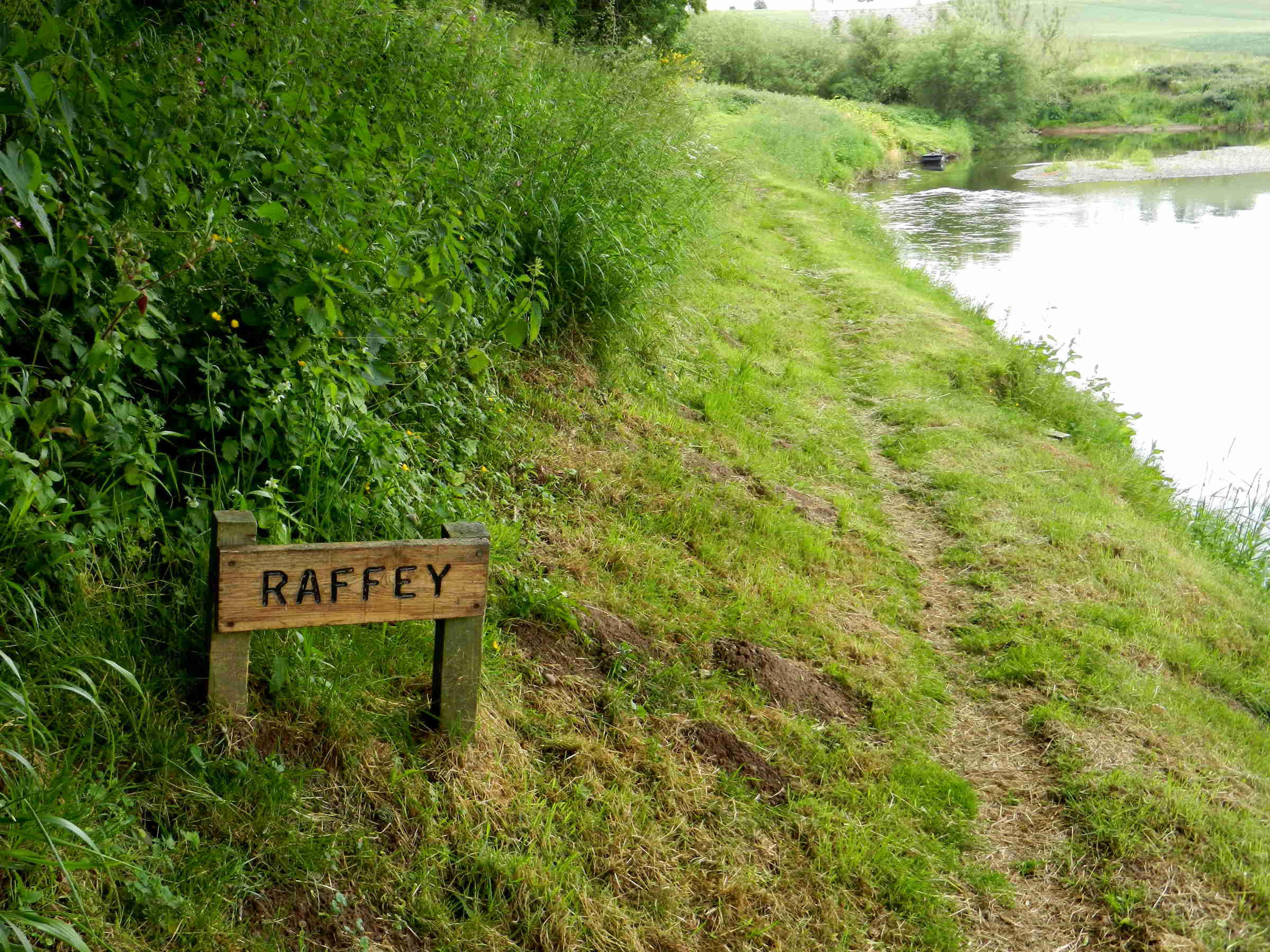
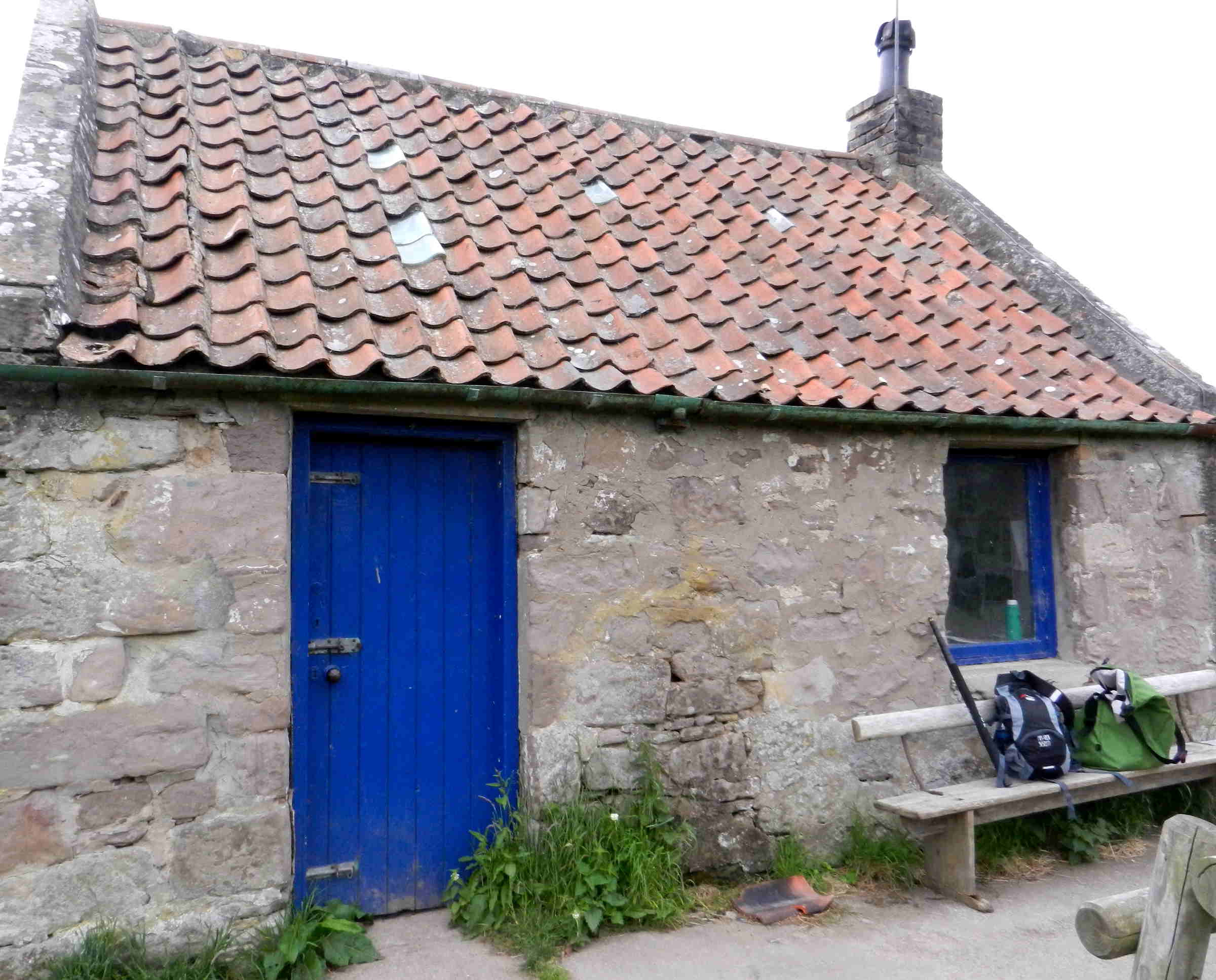
Walking downstream to ‘The Rocks’ you pass numerous small wooden signposts marking the beats. The bothy at The Rocks is another fine listening point opposite sandstone crags. This stretch in its entirety offers an excellent soundwalk. Here I spoke with two Northumbrian anglers who told me the following:-
- Tillmouth salmon fishing costs around £70.00/day but at peak season can cost up to £700/day.
- An angler caught six fine salmon yesterday (he was out on a boat again today on the same beat). The young lad I spoke to was looking out an orange fly which seemed to be doing the trick. The colour of fly, as opposed to the specific fly, seemed to be the deciding factor.
- Poachers are rare because the authorities have devised methods of testing for river fish which prevents quick and easy black market sales.
- Scottish rules (whatever those are) are in force for angling on both sides of the river.


Eventually the path rises away from the river to Twizel farmhouse. Some kind of high pressure siphoning from the river is taking place for irrigation purposes, no doubt closely monitored according to the statutory regulations in the Tweed Catchment Management Plan. Either that or I’ve just alerted the authorities and somebody’s about to be nicked.
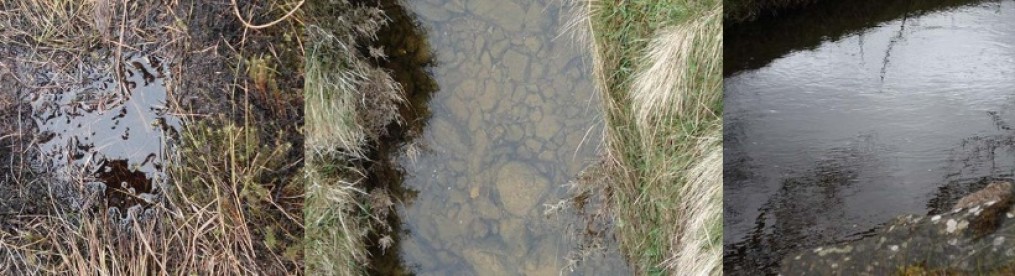
Of the three paths on offer I descended again to the river towards Norham. Here the path runs high above the Tweed affording tantalising glimpses of the river through the covering of thick wood and luxuriant vegetation. At times the woodland soundscape is Edenic, broken occasionally by startled waterfowl. Some notes and observations: this is a path less travelled, almost completely overgrown in places; no midges – you couldn’t walk this kind of path on the West Coast in comfort; the joy of brushing against riverside oak, too rare in Scotland these days; a series of excellent contrasting listening environments, especially from the small footbridges over tributary streams which offer resting points, in particular the bridge facing the rushing weir before Dreeper Island.
Just after Dreeper Island the river opens out and you’re level with a completely different Tweed, now expansive and slow flowing, more like a large lochain, which soon folds back into various canalisation morphologies. Traces of wild garlic, a riot of songbirds and incongruous but inviting rondavels on the opposite bank at Upsettlington, a meeting place for warring parties during the wars of Scottish Independence.
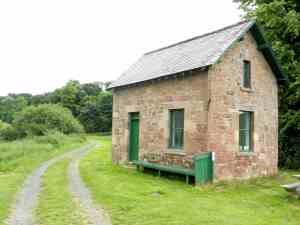

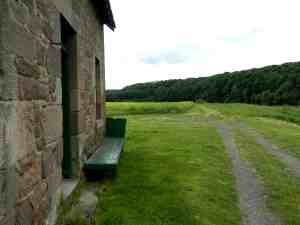
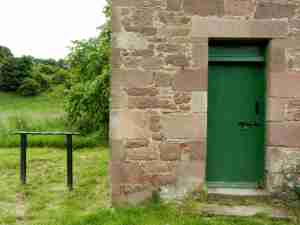
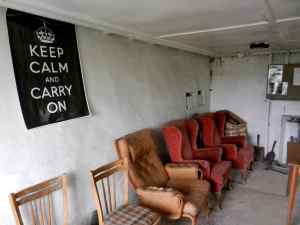
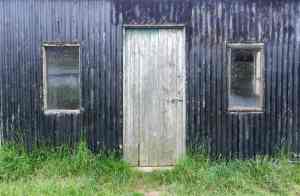
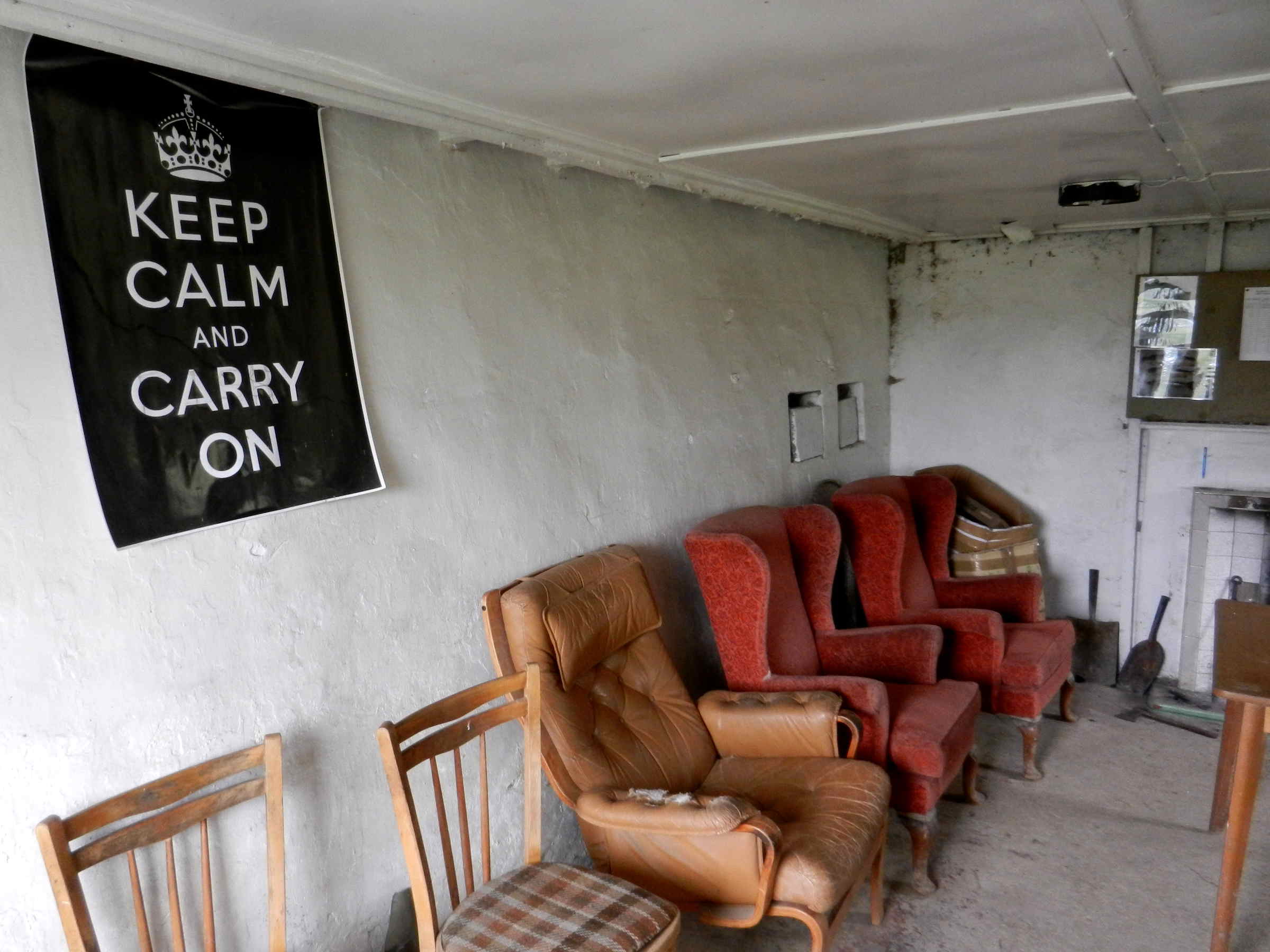
Finally on listening points, I’d recommend a stop at any of the bothies along the way, especially the black painted corrugated iron shack upstream of the small weir.
Returning by a different set of paths marked out on the map wasn’t easy or pleasant. What looks like a straight run of open land is actually waist- and even head-high with various crops. Creative cartography is required to avoid damaging the crops, so out of respect for the farmers I’ll refrain from mapping a return course and recommend that during the summer months you either aim for the nearest road as soon as possible or return the way you came. But I should mention to finish that the liminal zones between thick broadleaf woodland and hay meadows are unspeakably beautiful with their secret and intimate moods, as are the random explosions of poppies which pepper the fields of oilseed.



Next up – soundwalking and listening somewhere around Scott’s View and Bemersyde.







 4th April 2013 6.30-8.30pm
 This is a chance to hear firsthand about their experiences in Estonia, how they responded to the impressions and surroundings of MoKS, and more about how the MoKS model works. It’s also an opportunity to discuss how residencies develop artistic practice, and what links we can make now and in the future with international residency programmes. MoKS is set in Mooste – a very rural part of Estonia – and there were many intriguing parallels and differences with respect to the Borders.
 Working the Tweed