Working the Tweed Opens in the Gallery at Harestanes on Wednesday

Working the Tweed opens in the Gallery at  Harestanes Countryside Visitor Centre on Wednesday October 9th.

Download an eflyer here Working The Tweed at Harestanes Countryside Visitor Centre

It’s sometimes easy to forget just how much the Tweed and its rivers define our region and so it’s particularly appropriate that these four artists have chosen such a fundamental subject for their creative investigations.   Harestanes Centre Manager Michael Scott.

Assisted by  Tweed Forum and Southern Uplands Partnership and supported by the Scottish Borders LEADER programme, Working the Tweed has been exploring some of the lesser known aspects of the Tweed and its tributaries; from re-meandering to fish-tagging.

The biggest surprise for me has been discovering the extent to which we have produced and created so many aspects of the so-called ‘natural’ environment. James Wyness

Information gathered though field visits and riverside meetings with scientists and river specialists has provided the material from which the project room work has been created , encompassing drawing, film, sound and textiles. The project room is about bringing a creative process and a different perspective to specialist knowledge.

There is a huge wealth of knowledge about the river to draw on. My task has been to find creative ways to show some of the complexities of the river system. It’s been a playful process too, even getting educated about diggers and the difference between a front loader and an excavator.” Kate Foster

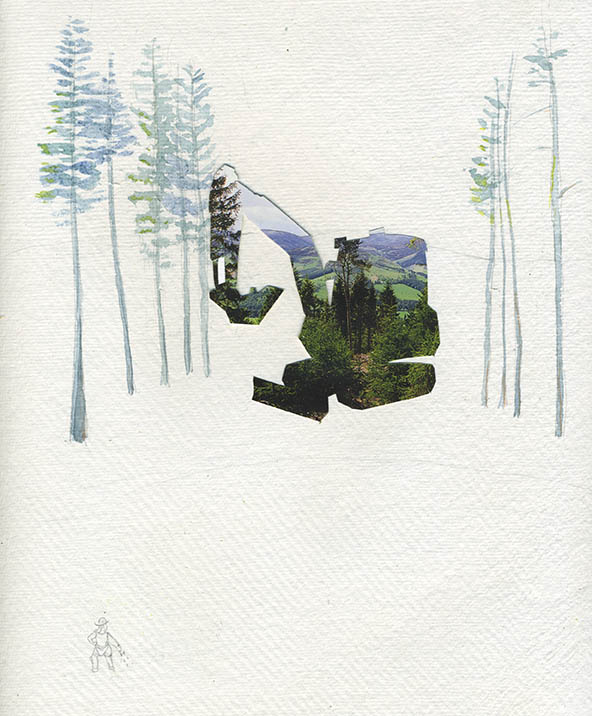
'Cryptic Digger' Collage, watercolour and pencil by Kate Foster Credit: Kate Foster and Forestry Commission.

‘Cryptic Digger’ Collage, watercolour and pencil by Kate Foster Credit: Kate Foster and Forestry Commission.

Working the Tweed is a collaborative endeavour.

The joy of working on a group project is that you arrive at ideas collectively that you would  never arrive at on your own.  Claire Pencak

Public events and activities like Knowing your River, Riverside Meetings with artists and river specialists and the Tweed Sessions have generated conversations all over the region around the river and what it means to people. This focus on social and public engagement has had a major impact on the direction of the project and it is represented  through the River Way drawings made by people over the summer and the voices of people on sound recordings.

 It has been a privilege to learn from people doing different kinds of work around the River Tweed and understand how the Borders is shaped and interconnected by the river catchment. It’s made me see the region in a new way.  Jules Horne

‘Tweed Tweed’  Jules Horne with thanks to Tweed Forum & CBEC. Credit:  Jules Horne.

‘Tweed Tweed’ Jules Horne with thanks to Tweed Forum & CBEC.
Credit: Jules Horne.

Working the Tweed  runs  from October 9th to October 31st.

The Gallery is open daily from 10am – 5pm at Harestanes Visitor Centre, near Ancrum, Scottish Borders, TD8 6UQ

Harestanes Countryside Visitor Centre  is part of Scottish Borders Museums and Galleries Service. The centre holds a Gold Award for Green Tourism and is a VisitScotland 4-star attraction.

On ‘passing-through places’, ‘so-far stories’ and movement improvisation.

Leah Gibbs (LG), Human Geographer at the University of Wollongong, Australia, in conversation with Working the Tweed artists, Kate Foster (KF) and Claire Pençak (CP).

Introduction

In the project Working the Tweed, we set out to work with different kinds of specialist knowledge. This yields various ways to think about the Tweed Catchment, and make different artistic connections and new kinds of maps. We are thinking through what we, as artists, might offer in engaging with projects that deal with sustainable land-use and the realities of environmental change. We are delighted to be able to converse with Leah Gibbs, a human geographer at the University of Wollongong, whose work concerns the cultures and politics of water. Leah has considerable experience of multi-disciplinary work focussing on land management. She explains her concept of ‘passing-through places’. This overlaps with Kate Foster’s ideas of documenting ‘so-far stories’, and Claire Pençak’s thinking on improvisation as a way to investigate relationship to place through movement.

Conversation

KF: Leah, you have written about ‘passing-through places’, which is an intriguing idea and keeps coming to mind as we plan the Working the Tweed project. Can you explain why you find the concept of ‘passing through’ helpful, and how you came to adopt the term?

LG: The idea of a ‘passing-through place’ emerged from a project I’ve been involved with over the last few years called ‘SiteWorks’. SiteWorks is an ongoing series of collaborative projects, which was initiated by arts organisation Bundanon Trust, and is based on the Shoalhaven River, just south of where I live in Wollongong (south eastern Australia). It involves a really interesting, shifting group of people: arts practitioners, scientists, other scholars, local people, including folk involved in Landcare groups, and other local organisations. The project asks participants to respond to the Bundanon sites on the river. I was thrilled to be invited to be part of it in 2010.

leah1

Image 1: Looking down the Shoalhaven River from Bundanon property ‘Riversdale’, August 2010.
Photo © Leah Gibbs 2010.

As a Human Geographer, I’m really interested in people and place, so when I first visited Bundanon I was keen to learn about people’s relationships with the site, and also how an arts-science collaboration might help us to understand place. I quickly learned that Bundanon is important to a lot of people. But it’s a place that people tend to pass through: visitors to the site, school groups, artists in residence, Bundanon employees, all pass through this place. We learn, and make connections, but we don’t dwell here. The previous owners of Bundanon were the late Australian artist Arthur Boyd and his family. Bundanon shaped a large body of Boyd’s work, and the place is strongly associated with him. But he and his family lived here for a relatively short time. Learning from the archive, it seems earlier settler families also passed through this place.
There has been some recent work done on the Indigenous heritage and history of the Bundanon properties, and this work finds that the main population centre prior to European colonisation was downstream, near the estuary. But the site was still important: people passed through here, often travelling on the river, to get to food and hunting sites, and to ceremony sites.
So what I’m trying to get at with the idea of a ‘passing-through place’ is that some places may not be permanently dwelt in, but are extremely significant, vital places none-the-less. Permanent dwelling, fixity, longevity, are not the only ways of forming meaningful relationships with places.

Leah2

Image 2: Across the floodplain, March 2011. Photo © Leah Gibbs 2011.

In addition, in Australia – as in other parts of the world – the idea of ‘belonging’ is highly political. It feeds into thinking about ‘native’ and ‘introduced’, ‘invasive’ or ‘feral’ species of plants and animals, and it goes on to inform management and decision-making about these things. Ideas about belonging also influence thinking and action towards people, particularly in the context of indigenous relations, ethnicity and migration. But belonging is highly complex in a settler-dominated society. Concepts of belonging that are based on fixed notions of permanence or longevity in a place can lead to some very troublesome, racist attitudes and even policy.
So I like the concept of a ‘passing-through place’ for a couple of reasons. First because it highlights the significance of places that may not be permanently dwelt in, but are vital none-the-less; and second, because it unsettles fixed notions of belonging. And it strikes me that challenging fixed ideas of belonging is incredibly important in the context of contemporary environmental change. It’s in this context that we need to learn how to better live with other humans and a more-than-human world under changing conditions.
I’ve written more extensively about the idea of a ‘passing-through place’ and my experiences as a SiteWorks participant in a recent article published in the journal ‘Cultural Geographies’.

KF: What you have said shows how ‘unsettling’ a fixed idea can be a constructive step to take. I am wary when I hear ‘The Story of X, Y, Z’ – all in capitals. Intellectually we might know that many different stories can be told but they do still jostle for position. We seem to shy away from complexity. Happy-endings can appeal – but for whom, where, and in what timescale?
I used a prompt from political ecology to work out how making ‘so-far stories’ can expand my human viewpoint. I borrowed this from the work of geographer Doreen Massey who asks us to think of landscape as an event, as a simultaneity of ‘stories-so-far’.  This is a sketchbook extract, written when drawing a thistle being blown in the wind.

kftextimage

Image 3: sketchbook extract © Kate Foster 2011

I know that geographical theory takes time and work to absorb, and believe that a rigorous and self-disciplined approach, learning from shared experience, is important. The idea of simultaneity (at different timescales) by-passes anthropocentrism. I set out artistically to attaining ‘ecocentrism’ but I am re-thinking this. I realise that learning about human environmental impact – and degradation – has also taught me more about what it is to be human. This is what I wrote in that article:

Unfinishable as they are, so-far stories may afford possibilities and juxtapositions that escape an aesthetic of despair. Of course the prompt might be anguish or anger, but fury and grief should not overwhelm quieter voices and tender ways of working, in order to acknowledge complexity.

KF: Claire, can you say more about how you use movement improvisation to explore place? Perhaps it’s best to be there with you to find out for ourselves! Does it help to document this kind of exploration? If so, how?

CP: There are several things here.
There is movement improvisation as a way of working that encourages an open, responsive and playful approach and doesn’t require that you follow a series of set steps. There is also the dancer whose body is a passing through place, a transformative place and place of flux. And there is the witness.
For me improvisation encourages thinking on your feet.  It is about responding to and being in relationship to – a person or a place or an object or an idea – at a given time, season and place.
It is a process towards finding ways to traverse, to move around, over, under and through that might offer opportunities to be in a slightly different relationship to place.  By not having to follow proscribed procedures and pathways it permits us to wander off the beaten track.
This way of working could suggest other ways to understand what place might or could be. It would certainly suggest that place is neither static nor singular but is in a state of becoming and is shaped by the interactions that take place there. If the dancer shifts – does the place not shift too?
For me this is a performative relationship.
Dancers are trained for years to literally place themselves and also to traverse, to pass through.
A dancer brings a different way of paying attention, an under_standing* that is corporeal, terrestrial and aerial.  Flux is where they are most at home.
Improvisation isn’t really something to be captured through documentation – it can be experienced, recalled and discussed but doesn’t take well to being fixed as it is thinking in action. The body ‘thinking’ through action.
It can though stimulate images, dialogue, writing.
I like the idea of a companion or witness, as their presence brings a creative eye to the process.
Improvisation is not a spectator sport but collaboration. The witness is there to look closely. They bring their eyes and ears and their presence. They are viewing points and can chose to shift their point of view and their focus of attention and so contribute to the improvisation.
The documentation lies somewhere in the dialogue between the dancer and the witness.

paxontkf

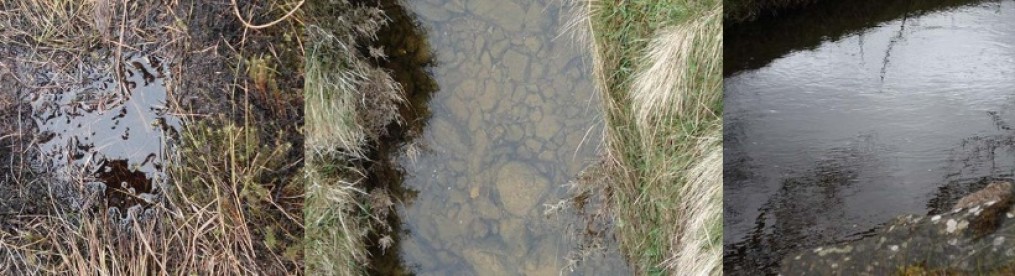
Image 4: Participants at Working the Tweed Riverside Meeting, August 2013. We were looking under a bridge to find traces of otters using the river and marking territory. Photo © Kate Foster 2013.

This conversation has begun to show how human geography, visual art and dance can interweave. Having glimpsed the insights that geographers can offer, our next discussion will be about why ‘more-than-human’ might be a helpful term that expands on traditional ideas of Nature.

References

http://smah.uow.edu.au/sees/eesstaff/UOW080115.html
http://www.bundanon.com.au/siteworks
http://www.bundanon.com.au/
http://cgj.sagepub.com/content/early/2013/05/17/1474474013487484.abstract
• Gibbs L In Press Arts-science collaboration, embodied research methods, and the politics of belonging: ‘SiteWorks’ and the Shoalhaven River, Australia. cultural geographies doi: 10.1177/1474474013487484 (published online 17 May 2013).

• Massey, D. 2006. ‘Landscapes as a Provocation: reflections on moving mountains. Journal of Material Culture, 11(1-2), pp. 33–48.

http://www.politicalecology.org/2012/01/responses-where-is-politics-in.html

Footnote

* When Claire Pençak speaks about under_standing, she gives it a certain emphasis. Translated into text, using the underscore intends to convey the idea that we stand from underneath – that standing is ‘feet up knowledge’.

Rights: Text © authors, Leah Gibbs, Claire Pençak, Kate Foster, unless otherwise stated. Images credited individually.
Riverside Meeting 1 – Paxton-Berwick

The boat is late. The tide is touch-and-go. Hot weather has dropped the levels in the Tweed and the Paxton-Berwick shuttle is waiting for safe passage.

We’re five miles inland on the river at Paxton House, among landscaped gardens, fields of sheep, a tractor mid-harvest over on the English bank. A seaboat in this calm farmland idyll seems unlikely, almost alien. But here she comes, On a Promise, a yellow-white skiff skippered by David Thompson, fresh from the port at Berwick. David has a quick catchup with the netsmen and then it’s off down the widening Tweed to the sea.

Martha Andrews, Paxton curator. Image © Kate Foster

Martha Andrews, Paxton curator. Image © Kate Foster

The crew for the first Riverside Meeting: Kate, visual artist, Sandy, musician, Jane, theatre maker, Claire, dance maker, Bridget, poet, Jules, playwright, Cath, textile designer, Michael, venue manager, and Janet, a crime writer scouting for likely murder haunts.
Martha Andrews, the Paxton curator, fills us in. Paxton is one of only two netting stations left on the River Tweed, from its heyday of around 80. George and Jo Purvis run a small commercial fishing operation – the rest have been bought out for ‘the rods’.

Netting at Paxton

Netting at Paxton. Image © Michael Scott

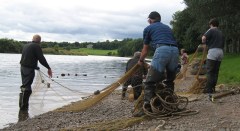
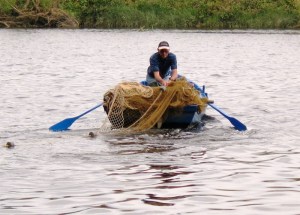
George spots a change of wind, the ripple of salmon heading upstream. Reading the river, its subtle signs. The rowboat heads out in a wide loop, the nets splashing cork by cork from the boats. As the team pull the net in, the corks dip – a sign of a catch. Once landed, the fish are rushed to the anaesthetic-tub and tagged by Tweed Foundation. Ronald Campbell’s industrial strength stapler plants a yellow plastic cable in the fish’s side. The groggy fish comes to in oxygenated water and is ferried back to the Tweed.

Dr Ronald Campbell of Tweed Foundation tagging a salmon

Dr Ronald Campbell of Tweed Foundation tagging a salmon. Image © Michael Scott

Ecologist Melanie Findlay is an otter specialist. A nearby bridge looks a likely spot. Sure enough, otter spraint. It has an earthy, metallic smell. Kate makes spraint-marks in her notebook. We hear about Himalayan balsam and Japanese knotweed, and compare with sycamore, ground elder, sea glass… will today’s scourges also be transformed by time?

Ecologist Melanie Findlay at Paxton

Ecologist Melanie Findlay at Paxton. Image © Michael Scott

On the boat, we pass the abandoned shiels of the netting industry, some just roofless ruins, some renovated as holiday retreats. At some point, our lips start to taste of salt.

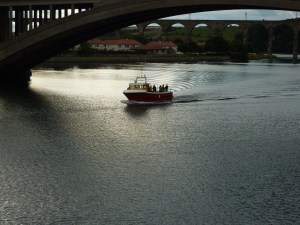
Rounding the last meander, we see the bridges of Berwick as we’ve never seen them before. From low in the water, passing beneath the sleek A1 concrete, the Victorian railway arches, the ancient pink sandstone, it’s as though history unfolds. Two territories, one each bank, connected and divided by a river.

Someone mentioned the word ‘rival’ derives from the Latin for river. ‘Rivalis‘ – ‘an adversary in love’. Neighbours in competition. Maybe our forebears once stood on the bank each side? Waving, shaking fists, and then rowing across, bartering fish, grain, daughters.

Arriving at Berwick. Image © Claire Pencak

Arriving at Berwick. Image © Claire Pencak

Bridges, Berwick

Bridges, Berwick. Image © Michael Scott

Bridges, Berwick. Image © Michael Scott

Bridges, Berwick

Sheep and swans from the Paxton boat

Sheep and swans from the Paxton boat. Image © Michael Scott

Tweed shiel and salmon lookout.

Tweed shiel and salmon lookout. Image © Michael Scott

George Purvis laying nets

George Purvis laying nets. Image © Michael Scott

Paxton netting team

Paxton netting team. Image © Michael Scott

on a promise: Riverside Meeting at Paxton

promise

field drawing © Kate Foster

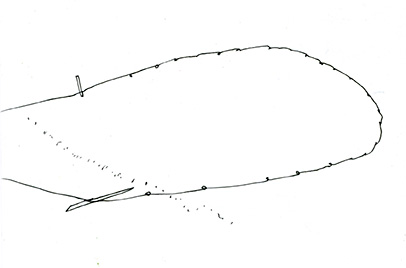
We watched the nets being laid out across the tide, learning that some fish ‘cheat the net’.

promise1

field drawing © Kate Foster


What, I wonder is the N for, on the coble’s stern?

promise2

field drawing © Kate Foster

N … for Norham? The coble’s fishing port?We talk to a bailiff.

The possibility is raised that it is labelled N because the boat always swings North – just like a magnet.

We talk to the boat owner.

N, for Ned. No, NET.

That’s to say it’s registered to fish, in legal hours

paxtonkf2

photo © Kate Foster

Another boat arrives, I am excited: we will sail with the falling tide, on brine, to Berwick-upon-Tweed.

promise3

field drawing © Kate Foster

I can’t help noticing how big the sheep are, in England.

promise4

field drawing © Kate Foster

Sport not Profit, a notice on our vessel remarks. Swans, herons, cormorants. Our youngest crew member is disappointed that nothing pink is visible on the banks.

promise6

field drawing © Kate Foster

promise9

field drawing © Kate Foster

So many shiels that need saving! Ninety six altogether on the river we are told: some are just a pile of stones though.We also learn about the bridges: the by-pass bridge built in 1885. The concrete cast bridge from 1935. The railway bridge, the longest in its day in 1850 – opened by Queen Victoria. She thereafter closed the curtains in Newcastle as she travelled by (because refreshments at that station made her late for her Berwick bridge appointment).  And a much much older bridge, built by an early King, who was afraid that the tide and wind would prevent his return to London.

We ourselves land, in sunshine and calm seas.

Cogsmill Burn – Slitrig – Teviot – Tweed: World Listening Day Reflections

I set off on the bicycle to find the junction of Cogsmill Burn and the Slitrig Water, which later joins the Teviot at the point where the heron fishes in Hawick.

Cogsmill Burn is my closest water way and runs a couple of fields away from the back of the house.

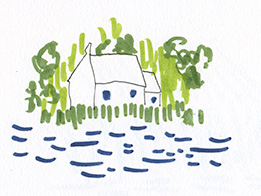
It passes Cogsmill Hall – the pink hall which will soon be pink no longer – and under a bridge – and somewhere between that point and before the pig farm it runs into the Slitrig.

From the road, the junction is concealed. Instinct suggested it was somewhere behind the big gated entrance to Stobs Estate.

The sound of flowing water is audible and a broken down wall offered a glimpse of it, so leaving the bike, it was a scramble down the bank to a shady river – which one, though? I thought the Slitrig, as it seemed unlikely the Cogsmill Burn would have widened quite so much in such a short distance, so upstream seemed the most likely direction to find the meeting place. The riverbanks were lush. I noted hawthorn, beech, ash , rhododendron, hogweed, campion, wild garlic, raspberry and dock.

Slitrig Water Photo Claire Pencak

It was difficult to move through, and the easiest way to make any distance was by taking to the river. I imagined this might have been how the first people moved up the tributary.

After a good ten minutes or so of slow river walking, there it was, the meeting place of the Cogsmill Burn and the faster flowing, more chattering Slitrig Water.
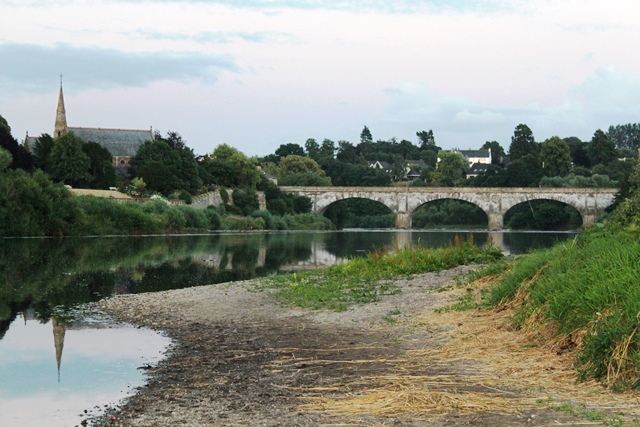
meeting cogsmill and slitrig

Listening is a continuous, subtle adjusting and shifting of your weight as your feet negotiate stony riverbeds.

River Listening

It is a state of opening up and out through all the senses.  A present tense state of being in complete attention. We might talk about listening with the soles of your feet, the sternum, the back of your neck.

July 2013 064

It occurred to me that it wasn’t the water that I was listening to but the flow, the passing of the water that sounded the stones and branches and plants that it moved over, under and by.

I thought I was hearing voices on a distant radio somewhere but this turned out to be the conversation of a specific combination of river, stone and branch in one specific place very close by.

flowing conversation in the Slitrig

The ‘over there’ and ‘out of sight’ of passing cars travelled to me as sound even though the road was up the bank and the other side of the wall.  I could hear the cars through the wall even though I couldn’t see the cars through the wall.

Dipping a long, slim branch into a faster part of the water and allowing it to be taken by the river whilst still holding the other end, it was easy to sense the rate and energy of the flow which seemed to want to take it with you. This was easier to experience through the medium of the branch than by placing my hand into the river. The energy of the flow could be more sensitively felt when channelled through the branch into the hand and arm and finally the spine, and I thought I could perhaps begin to understand what it must be like to know the river with a rod and line and knew that this was river listening too.

Later in the day I passed the junction of the Slitrig with the Teviot on its way to join the Tweed at Kelso.

slitrig meets teviot


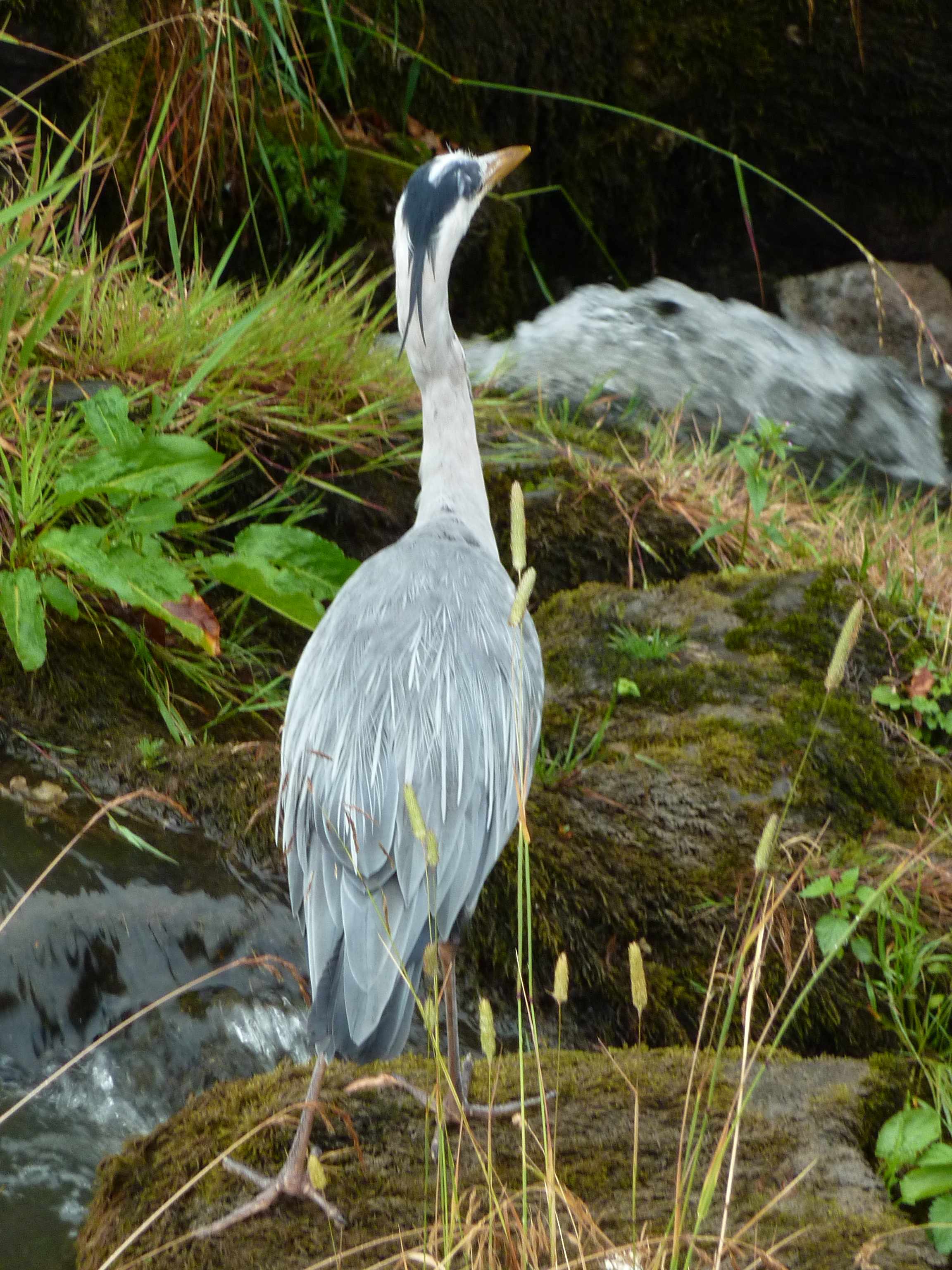
The heron was riverside listening too.

Heron on Slitrig


Artists’ Paxton Netting and River Trip – 10th Aug

Calling Borders artists! Would you like to join a Riverside Meeting at Paxton, followed by a Tweed boat trip on the new Paxton-Berwick shuttle service?

This is the first in our series of six meetings between artists and river specialists, and it’s aimed at uncovering the hidden world of river work and making links between the arts, environmental and science communities, as well as cross art-form.

Get picked up by shared minibus from various parts of the Borders, then we head to Paxton for a riverside gathering to hear from Dr Ronald Campbell, fish biologist at the Tweed Foundation, Melanie Findlay, ecologist specialising in otters, and Martha Andrews, the curator at Paxton House. It’s a rare chance to see river netting and hear about the changing fish patterns in the Tweed catchment. Then we head downriver on the ‘On a Promise’ with skipper David Thomson to the mouth of the Tweed at Berwick, accompanied by Mel with her insights into the local wildlife. The boat can only carry 12, so please book your place soon! Deadline Fri 2nd Aug (later than on application form).

Download Riverside Meeting Paxton details here.

Download application form here.

Many thanks to Tweed Foundation and Paxton House for their support with this event.

Working the Tweed at the Border Union Show

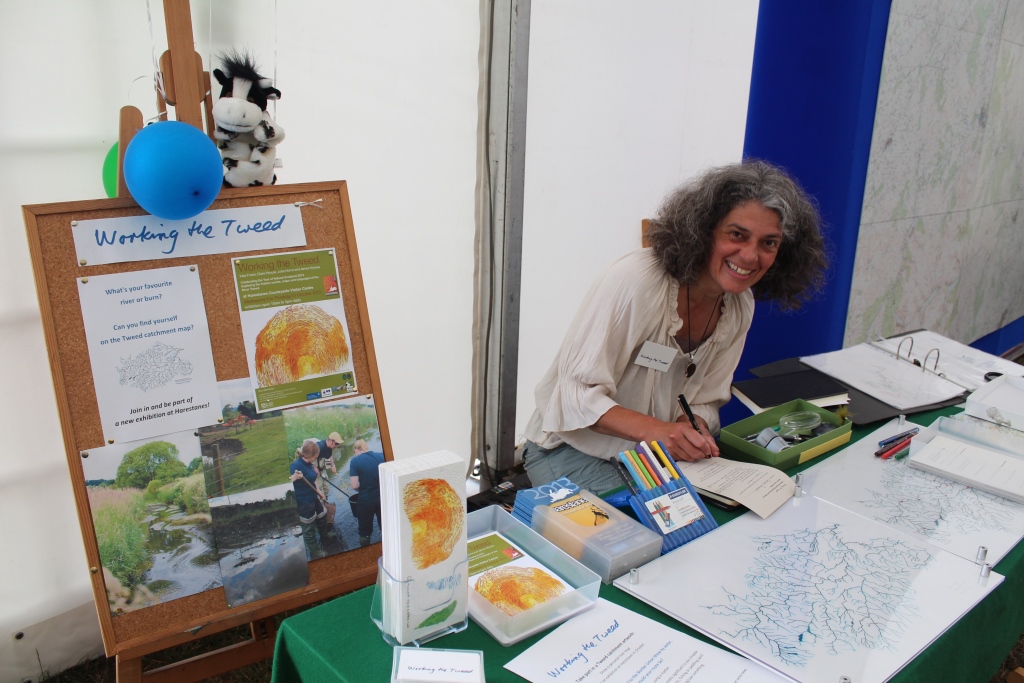
Working the Tweed at Border Union Show.

Working the Tweed had a lovely weekend at the Border Union Show thanks to Tweed Foundation, Tweed Forum and the Border Union Agricultural Society, who let us share their marquee.

    ClaireatBUS3 small

We were placed next to a large map of the Tweed which belongs to Border Union Agricultural Society, and made an interesting contrast in scale to the Tweed Catchment maps drawn by Working the Tweed artist Kate Foster.

Kate’s maps caught people’s attention and imagination because they reveal the complexity and density of the Tweed catchment, which is the most dendritic in Europe. As one person noted, it looks just like a lung.

Knowing your River Border  Union Show CP

The maps are one element of Knowing your River, a family activity which encourages us to consider where we are each placed within the catchment and how the Border region is connected through the many burns and tributaries which eventually all meet and flow into the Tweed.

After a slight pause for thought, many people were able to find whereabouts they were located on the map, which shows the fantastic amount of river knowledge that people have in the Borders.

I liked this local river knowledge encapsulated in a verse:

The foot of the Breamish and the head of the Till
Meet together at Bewick Mill.

People used the catchment ink drawing to make a tracings which showed their river journey to Kelso if they had travelled there using the water ways. By adding other details of favourite haunts, activities and memories, these transformed into personal maps of stretches of the rivers. These will all feature in the Working the Tweed exhibition at Harestanes Countryside Visitors Centre, October 9th – 31st.

Jules Horne also collected ‘biological records’ about our visitors, along with what their local river means to them and what they might change if they could.

Making the most of having so many river specialist in the same space, we were introduced  to the art of tying  fish flies by Tweed Foundation, were entertained with lively conversations and stories by River Bailiffs Eric Hastings and Kenny Graham (below with Tracy Hall from Tweed Forum), and witnessed the difference that Natural Flood Management techniques can make to slowing down water as it moves through an area through the Tweed Forum’s comparative catchment models.

baiilffstraceysmall

Next weekend we will be at Kailzie Wildlife Festival, Kailzie Gardens.  http://www.kailziewildlife.org/

World Listening Day – a selection of links

A selection of work celebrating Riverbank Listening, our  contribution to World Listening Day 2013 :-

Bridget Khursheed: Huntlyburn meets the Tweed

Jules Horne: Teviot meets Tweed: Junction Pool at Kelso

Kate Foster: listening upriver, downriver

Claire Pençak: junction of the Cogsmill Burn and the Slitrig

Felicity Bristow: Laret Burn – The Embankment – Kirk back

Joy Parker: meeting of theYarrow and the Ettrick

Fin McDermid: Leader joining the Tweed, with anonymous bird and low A68

Chris Whitehead: where the small Murk Esk joins the River Esk at Whitby

James Wyness: junction of the Jed Water and the Teviot

Chris Hurst: where a burn meets the Tweed with participant coughs, a Border Biscuit barking and a taciturn frog in the burn

Teviot meets Tweed

The nearest river junction to my home is in Kelso. It’s Civic Week.

We live up on a hill. Listening over the past couple of nights, we’ve heard fireworks in the sky. Celebrations down in the valley.
Today, on World Listening Day, the people and parties are gone. We’re hearing a hangover.

IMG_0201

Kelso’s characteristic sound is its cobbles. Growing up, I lay awake in my grandparents’ house in Horsemarket, listening to cars rattling across the cobbles, the drunk race-day men pouring from the pubs, grandad’s unearthly snore, like a slow echoey giant walking the timbers overhead. It wasn’t a place to sleep easy.

By the Junction Pool, where the rivers Teviot and Tweed meet, Kelso is obliterated by a constant rush of white noise. The pool itself is quiet, the water slow-moving. The white noise comes from a cauld, used by the salmon and trout to travel upstream. A small waterfall, in essence. It’s like a soundbed that cushions and blunts everything else.

Junction Pool, Kelso

Layers pierce through. On the far bank, a couple laughing. Overhead – birds. I don’t know birds. Gulls? Something crow-like? Squawks and tussles in the air. Mike is with me and we listen. He names them. Black headed gull. Jackdaw. Something lighter, more delicate – swallow. Very far off – grey wagtail, I’m told. I wasn’t tuned in. I missed it.

Mike hears a birdmap when we go out walking. Each individual, its life, its territory, its name. My own birdmap was always a crude cartoon. Pheasant, cuckoo, and dislocated twittering. But lately, I’ve been learning birdsong ID near my home. The soundscape is pulling into focus. Yellowhammer. Martin. Curlew. Blackbird. Now I can’t get them out of my head. They’re everywhere, vivid. Beaks, lungs, feathers. It strikes me that listening is changed by naming.

Junction Pool, Kelso

Far in the distance, there’s a man shouting through a tannoy. The shows are in full swing, way across the other side of the town. His voice carries over the field, the river. Rags of amplified sound. His lips, a microphone, a cable, amp, speaker, all the way across Kelso to our ears.
Other sounds, close by: the click of a shutter, a blop of rising fish, Doppler flies. Our clothes, hair rustle. A generator drone.

We’ve lived here 12 years. It’s the first time we’ve stood on the bank at Junction Pool.

See video here.

Junction Pool, moon

listening upriver, downriver

Last Thursday’s mission was to walk to my nearest tributary junction, and join World Listening Day by paying attention to sounds. I had an equidistant choice of going upriver and downriver. I walked upstream late morning, and downstream in the early evening.

Going along the riverside road became part of the listening. There were signs of heat – grasshoppers, flies buzzing, swallows chattering.

LDcowdraw

field drawing © Kate Foster


Cattle are noisy eaters I learn –  a bullock catches my ears, grazing and wading in the burn (appreciating the coolness I assume).

DSC04040

photo © Kate Foster


My attention brings quiet, as the herd pauses to look at me.

Through the gate to the next holding, I am wished Good Listening by the neighbour who farms there. She tells me of a band of thirsty scouts, concerned for them in this heat as they walk down this reiver’s valley to the Borders Abbey Way.

LDscoutsdraw

field drawing © Kate Foster


I meet the Scouts and we look at the map of their walk. I suggest which houses they can get water from. A mix of adolescent voices drift away: tired, broken and half-broken tones.

Now close to the burn, a skin-slap against a horsefly, the dog slumping in the river.  I stop in tree-shade and listen to water flowing: noticing that a fish-ripple is soundless but that a crow caw has two-beats.  I learn that few of the things I look at yield sound, and I see little of what I hear.

The particular chink of a gate; the stridulation of a cricket; a ewe moving through a wire fence (metallic string tone), cool wind in my ears – all can be heard.

The open thistle, bone dry grass, distant forming clouds – all quiet.

LDmapdraw

field drawing © Kate Foster


At the farm-bridge at the river intersection, I remember falling off, into the river, last summer. With children’s laughs ringing alongside my shock as the plank broke.

I realise my intersection map should have been of sounds not sight, but the allocated hour is up.

The evening mission starts with a swim in the loch and from there to the road-bridge, where the burn meets the river. The moon is visible – is it always silent?
Shoes giving a rubbery flap on dry grass. There is a nettle wall between the road and my chosen point. I manage through to see, on the opposite bank, a woman watering her garden in a bikini. She might take my watchful presence amiss.  My mistake: to consider visual rather than aural access. Hidden in bracken, I start to listen and things rapidly become more abstract.

LDriver2draw

field drawing © Kate Foster


I find I can’t listen well with my eyes open

LDeyesopen

field drawing © Kate Foster


I draw birdsong from above, mistakenly using pink (not exactly a flutey hue)

LDdrawmove

field drawing © Kate Foster


Drawing sounds becomes a movement. I compromise with half-closed eyes, but the midges have found me.

Click here for a thought-provoking TED talk by Bernie Krause on ‘The Voice of the Natural World’ that inspires me to keep listening.